The Modern Creator's Toolkit: Why a Customizable Music Note Book Is Essential
In today's creative landscape, the tools we choose define our workflow, efficiency, and ultimately, our output. For musicians, composers, educators, and students, the transition from inspiration to finished composition often bridges the gap between the analog and the digital. This is where the concept of a specialized Music Note Book evolves from a simple notebook into a critical component of a professional creative system. It represents a tangible space for ideation, structured yet flexible, designed to meet the specific demands of musical notation.
Beyond Blank Pages: The Music Note Book as a Structured Creative Environment
A Music Note Book is fundamentally more than a pad of paper with pre-drawn staves. It is a purpose-built environment for capturing musical ideas. Unlike generic notebooks, it provides the immediate structure—the clefs, measures, and staff lines—that musicians need to begin composing without the mental overhead of drawing their own framework. This immediate readiness is key in a fast-paced creative process where capturing a fleeting melody or harmonic progression is paramount. The physical act of writing on staff paper has long been valued for its tactile connection to the art form, a connection that many digital tools, despite their power, cannot fully replicate.
Alignment with Contemporary Creative and Business Trends
The resurgence of specialized analog tools among digital professionals is a notable trend. In an era dominated by software, there is a growing appreciation for tools that offer focus, reduce digital distraction, and provide a permanent, un-editable record of initial ideas. The Music Note Book fits perfectly within this movement. It serves as the indispensable first draft repository—the sketchbook that precedes the polished digital score created in Finale, Sibelius, or MuseScore. This workflow mirrors trends in other creative fields, where analog sketching precedes digital rendering.
Furthermore, from a business perspective, the demand for customizable, ready-to-use templates speaks to the rise of the creator economy. Professionals and entrepreneurs seek assets that they can adapt to their specific brand or teaching methodology. A Music Note Book that comes with source files in PowerPoint, Illustrator, and InDesign isn't just a product; it's a platform for customization. It empowers music teachers to create branded workbooks for their students, composers to design personal manuscript styles, and small publishers to quickly produce tailored materials for niche markets.
The Relevance of Ready-to-Publish Source Files
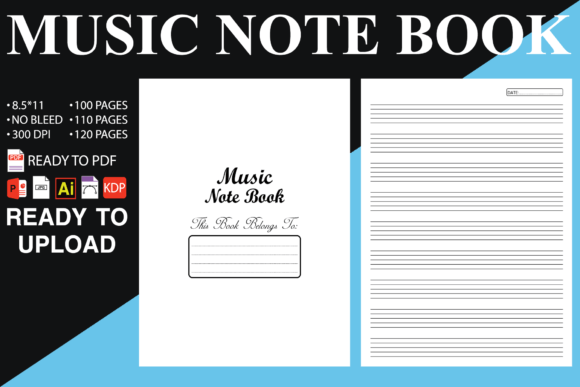
The specification of including PDF, PPTX, AI, and INDD files alongside the print-ready PDF is a direct response to changing professional needs. It acknowledges that today's creator is often also their own publisher, designer, and marketer. The ability to instantly download a Music Note Book with these source files removes significant barriers.
- For the Educator: A PowerPoint (.PPTX) file allows for quick adjustments to add lesson notes, exercises, or headers before printing classroom materials.
- For the Designer: Adobe Illustrator (.AI) and InDesign (.INDD) files provide complete control over the layout, enabling changes to staff spacing, margin designs, or the integration of other graphical elements for a premium publication.
- For the KDP Publisher: Having a high-quality, no-bleed, print-ready PDF formatted for the standard 8.5" x 11" trim size means the product can be uploaded to platforms like Amazon KDP immediately, turning an idea into a marketable product in hours, not weeks.
This package addresses a modern expectation: tools should be both complete and adaptable. Users no longer accept static, one-size-fits-all solutions; they demand the core product plus the keys to modify it.
Why Interiors of 100, 110, and 120 Pages Matter
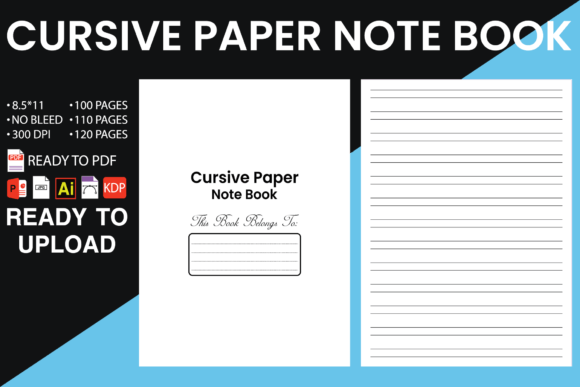
The offering of different page counts—100, 110, and 120—is a practical response to diverse usage patterns. A student or casual composer might find a 100-page book ample for a semester or a single project. A professional composer working on a larger piece or an educator preparing a full curriculum might require the extended 120-page version. This choice caters to different project scales and budgets, acknowledging that the creative process is not monolithic. It allows the user to select a tool that matches their project's scope, avoiding waste or insufficiency. This flexibility is a subtle but important feature in a product designed for serious use.
Connecting to Larger Developments in Publishing and Technology
The seamless integration from source file to published PDF mirrors the broader democratization of publishing technology. Just as blogging platforms empowered writers, and print-on-demand services empowered authors, customizable template packages empower niche creators. The music notation field, once reliant on specialized, expensive publishing houses for manuscript books, now has accessible, high-quality alternatives. This shift puts production control back into the hands of the content expert—the musician. It aligns with a larger development where technology enables specialization rather than enforcing standardization.
Practical Applications and Observations
Consider a freelance music teacher developing their own suite of teaching materials. With a customizable Music Note Book, they can quickly produce professional-looking manuscript paper that carries their studio's logo and teaching philosophy, enhancing their brand's credibility. A film composer can use the physical book for rapid, on-the-spot sketching during collaborations with directors, then later refer to these sketches when building the full score digitally. The physical book becomes an archive of the project's creative journey.
The inclusion of multiple source file formats also speaks to observed workflow diversity. Some creators are adept in PowerPoint for its simplicity; others require the precision of Illustrator. Providing all formats ensures the tool integrates into virtually any existing professional environment without forcing the user to learn new software. This interoperability is a mark of thoughtful product design in the current ecosystem.
The Future-Oriented Perspective: A Tool for Hybrid Workflows
Looking forward, the relevance of a Music Note Book is secured by the enduring nature of hybrid analog-digital workflows. As digital tools become more advanced, the value of a focused, off-screen initial capture phase may actually increase. This notebook is not a rejection of technology but a complementary partner to it. The provided source files are the bridge. One can jot down a concept in the book, then open the corresponding AI file to replicate that structure digitally for expansion and arrangement. This synergy is where modern creativity often thrives—in the handoff between different media.
Ultimately, a Music Note Book delivered as a complete, customizable package is more than a commodity. It is an acknowledgment of the musician as a multifaceted creator who operates in both the physical and digital realms, who values both spontaneous creativity and professional presentation, and who requires tools that are as adaptable and forward-looking as their own aspirations. It meets the changing need for autonomy, speed, and specialization in creative production, making it an essential component for the serious musician, educator, or publisher in today's market.