The Strategic Discipline of Sudoku Puzzle Practice: A Tool for Sharper Decision-Making
In the landscape of cognitive training and strategic thinking, Sudoku Puzzle Practice often transcends its recreational origins. For adults navigating complex professional and creative environments, the deliberate engagement with these logic grids serves not merely as a pastime but as a structured method for honing mental clarity, pattern recognition, and systematic problem-solving. When approached intentionally, Sudoku Puzzle Practice becomes a mirror for the analytical processes required in business planning, operational troubleshooting, and creative innovation.
Cultivating a Mindset of Systematic Analysis
At its core, Sudoku Puzzle Practice is an exercise in constraint satisfaction and logical deduction. Every puzzle presents a finite set of rules—each row, column, and box must contain a unique set of digits—and a partially filled grid. The solver’s task is to methodically deduce the correct placements, eliminating possibilities through inference. This mirrors the foundational challenges faced by entrepreneurs, marketers, and project managers: operating within defined constraints (budgets, timelines, market realities) to arrive at an optimal, coherent solution from incomplete initial data. Regular Sudoku Puzzle Practice trains the brain to seek out these hidden patterns and interdependencies, a skill directly transferable to analyzing customer data flows, supply chain logistics, or campaign performance metrics.
From Puzzle Grids to Strategic Planning
Consider the process of developing a new product launch plan. The market research, competitor analysis, channel selection, and messaging must all align without conflict or overlap—much like the numbers in a Sudoku grid. Engaging in Sudoku Puzzle Practice reinforces the mental habit of checking for alignment and coherence across multiple dimensions. It encourages a planner to ask: “If I assign this resource to initiative A, does it preclude its use in initiative B? Does this marketing message conflict with our brand positioning in another segment?” The puzzle’s grid becomes a metaphor for any multi-variable system requiring harmonious integration.
Intentional Practice for Enhanced Cognitive Agility
The value of Sudoku Puzzle Practice lies not in random completion, but in adopting a mindful approach. To leverage it strategically, one must set clear objectives for the session. Are you focusing on speed, to simulate high-pressure decision-making? Or are you focusing on a particularly tricky deduction chain, to improve your ability to navigate complex, multi-step problems? This intentionality transforms a casual activity into a targeted cognitive workout. For professionals and creators, this agility translates to quicker, more accurate assessments of situations, from negotiating a contract to debugging a creative project’s workflow.
A practical method is to treat your puzzle session as a scheduled “focus block.” Dedicate 20-30 minutes solely to Sudoku Puzzle Practice, applying the same undistracted concentration you would to a critical business analysis. Observe the techniques you employ—scanning, marking candidates, cross-hatching—and consider how analogous techniques appear in your work. For instance, “scanning” a Sudoku grid for obvious placements is like reviewing a quarterly report for immediate, glaring insights; the more advanced “candidate marking” is akin to deep-dive competitive analysis, where you list and evaluate multiple strategic options before committing.
Operational Insights Through Pattern Recognition
Long-term, consistent Sudoku Puzzle Practice enhances pattern recognition—a critical skill for anyone responsible for branding, customer experience, or operational efficiency. In Sudoku, patterns emerge from the arrangement of given numbers and the empty spaces they define. In business, patterns emerge from customer feedback cycles, sales data, or process bottlenecks. The trained mind, accustomed to spotting a “hidden pair” or “X-wing” pattern in a puzzle, becomes more adept at spotting recurring issues or opportunities in operational data. This can lead to proactive improvements rather than reactive fixes.
Risks of Uncontextualized Practice
However, the strategic benefits are contingent on context. Engaging in Sudoku Puzzle Practice without clear goals or as a mere displacement activity carries a subtle risk: it can become a form of mental isolation. If the practice is not connected to reflection or real-world application, it remains an abstract skill. The key is to actively draw parallels. After completing a medium-difficulty puzzle that required several layers of inference, ask yourself: “What complex problem at work currently feels like a grid full of possibilities? Can I apply a similar step-by-step elimination process?” Without this bridge, the practice loses its translational power.
Integrating Practice into a Professional Routine
For educators, freelancers, and small business owners, integrating Sudoku Puzzle Practice into a weekly routine can serve as both a mental reset and a skill-building exercise. It acts as a palette cleanser between disparate tasks, forcing the brain into a different, yet structured, mode of thinking. This shift can often spark creativity, as the rigid logic of the puzzle frees the mind from the fuzzy constraints of a creative brief, allowing novel connections to form. Furthermore, the satisfaction of systematically solving a puzzle provides a micro-accomplishment, reinforcing a growth mindset valuable for tackling larger professional challenges.
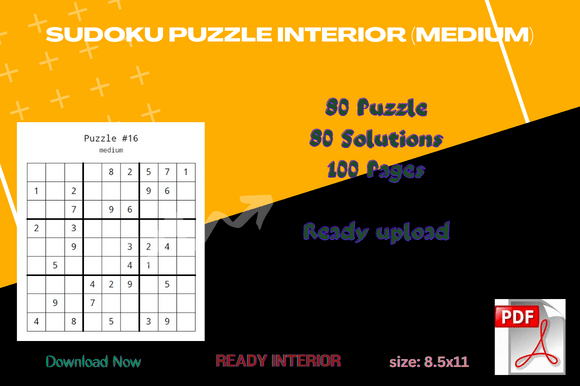
A resource like an 80 Sudoku Practice Medium Puzzle Solutions KDP Interior book offers a curated path for this integration. With one puzzle per page and included solutions, it provides a scalable framework. You can progress through the puzzles, noting how your solving strategies evolve. The medium difficulty level is particularly apt for strategic training—it requires genuine deduction without being overwhelmingly complex, mirroring the typical problem difficulty encountered in managing projects or optimizing marketing campaigns.
The Long-Term Value of Consistent Logical Exercise
The cumulative effect of regular, intentional Sudoku Puzzle Practice is a more disciplined, patient, and systematic approach to decision-making. In fast-paced environments, the pressure to jump to conclusions is high. The puzzle practice instills a habit of verifying assumptions and considering the system-wide impact of a single decision. For decision-makers and leaders, this translates to more robust strategies and reduced oversight errors. It fosters a culture of thoughtfulness, where every move is considered not just for its immediate effect, but for its implications across the entire organizational “grid.”
Ultimately, Sudoku Puzzle Practice is a low-stakes, high-reward simulation of high-stakes logical reasoning. By committing to it with the same strategic intent you apply to your professional goals, you cultivate a mental toolkit of deduction, pattern recognition, and systematic persistence. These tools, refined on the puzzle grid, become readily available for the complex, interconnected puzzles presented by your career, your business, and your creative endeavors. The path from a solved Sudoku to a solved business problem is not direct, but the cognitive muscles strengthened on that path are unequivocally the same.