Navigating Financial Goals: An Evaluation of Editable Money Saving Challenges Trackers
For many adults, the aspiration to build savings is clear, but the path to achieving it can feel murky. Traditional methods—setting a vague target or relying on sporadic deposits—often lack the structure and psychological reinforcement needed to turn intention into habit. This is where the concept of a Editable Money Saving Challenges Tracker enters the financial toolkit. It represents a specific category of planning resource designed to provide a visual, step-by-step framework for accumulating funds. Unlike a static budget spreadsheet or a generic savings account, these trackers are built around timed challenges with incremental goals, transforming the abstract concept of "saving" into a tangible daily or weekly action.
What Distinguishes an Editable Money Saving Challenges Tracker?
The core distinction lies in the combination of editability, structured challenges, and a print-ready format. As the name implies, an Editable Money Saving Challenges Tracker typically offers digital source files, allowing users to personalize aspects of the design before printing. This is a significant shift from pre-filled, non-modifiable planners. The editable component means you can adjust colors, perhaps add personal motivational quotes, or tailor headings to fit your specific mindset before committing to the physical product.
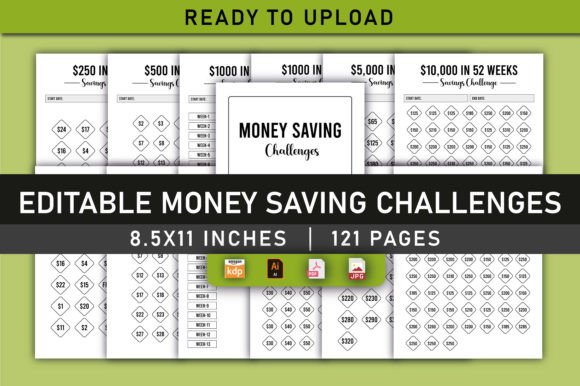
More fundamentally, the product is defined by its preset challenge frameworks. Common examples include "Save $250 in 24 Days," "$500 in 30 Days," or longer-term goals like "$10,000 in 52 Weeks." Each challenge is broken down into a tracker—often a chart, grid, or checklist—where you mark off each successful deposit. This visual progression provides a powerful sense of accomplishment and momentum. The specification of a high-quality print-ready PDF and complementary JPG source files indicates a product crafted for self-publishing or direct use, often meeting the technical requirements for platforms like Amazon KDP (Kindle Direct Publishing). The inclusion of multiple templates (e.g., seven different designs across 121 pages) within a single package offers variety, allowing a user to choose the aesthetic or layout that best resonates with their personal style.
Evaluating the Format and Its Practical Application
When considering a Editable Money Saving Challenges Tracker, it’s useful to examine its format against other common savings tools. Digital budgeting apps, for instance, offer automation, real-time syncing with accounts, and complex analytics. A physical tracker, however, leverages the psychological impact of manual engagement. The act of physically marking a cell after saving $20 can create a stronger cognitive reward than a passive app notification. This format is particularly suited for individuals who benefit from tactile interaction and who want to separate their savings challenge from their daily transactional banking environment.
The practical strength of a package offering multiple challenges—from short-term ($250 in 24 days) to ambitious ($10,000 in 52 weeks)—is its adaptability. A user can start with a shorter, high-intensity challenge to build confidence and discipline, then progress to a longer template. The 20-page count for each challenge suggests ample space for tracking, potentially including additional pages for notes or reflection. For the self-publisher, the technical specs like 8.5 x 11 inches, 300 DPI, and CMYK color are critical for professional print results. The "no bleed" specification means the design is safe for standard home or professional printing without requiring specialized trim.
Tradeoffs and Considerations for Potential Users
Choosing a Editable Money Saving Challenges Tracker involves weighing its focused approach against broader financial management systems. Its primary limitation is its singular focus: it is a tool for building a savings habit and reaching a specific numeric goal, not for comprehensive budgeting, debt tracking, or investment analysis. It excels as a complementary tool rather than a complete solution.
A key decision factor is the user's preference for digital versus analog systems. While the source files are digital and editable, the end product is intended for print. This requires access to a printer and a commitment to using a physical booklet. For individuals who are entirely digital-native and prefer all data on their devices, this format may feel cumbersome. Conversely, for those who find screens distracting or who want to create a ritualistic, offline savings practice, the physical tracker is a significant advantage.
The editability also presents a tradeoff. It offers customization, which can increase personal commitment, but it also requires a basic level of comfort with graphic software to modify the JPG or PDF source files. Someone looking for a zero-effort, ready-to-use printable might find the editing step an unnecessary hurdle, whereas a creative individual or a reseller might see it as the core value.
Identifying the Best-Fit Situations
An Editable Money Saving Challenges Tracker is likely the right choice in several specific scenarios. First, for individuals embarking on a dedicated savings journey for a clear purpose—a vacation, a debt lump-sum payment, an emergency fund—the structured challenges provide a clear roadmap. The visual nature helps when motivation wanes; seeing half the chart filled can reignite effort.
Second, it is a strong option for content creators, freelancers, or small business owners looking to create and sell printable products on marketplaces like Etsy or through Amazon KDP. The provided specifications (KDP tested, CMYK, 300 DPI) reduce the technical guesswork. The package of seven templates and 121 pages offers a substantial inventory of ready-to-adapt designs.
Third, it serves well for educators, coaches, or community group leaders who want to provide a tangible tool to clients or participants in financial literacy programs. The editable aspect allows branding or personalization for the group.
When Alternative Approaches Might Be More Suitable
There are situations where an editable tracker may not be the optimal tool, and recognizing these helps in making an informed decision. If your financial priority is not just saving, but also managing complex monthly cash flow with many variable expenses, a full-featured budgeting app or a detailed spreadsheet would be more comprehensive. Similarly, if your savings goal is not a fixed lump sum but a continuous, percentage-based investment strategy, other tools are better aligned.
For those who need constant, automated reminders and integration, a digital solution that links to your bank account and automatically transfers funds (like round-up apps or scheduled transfer tools) might yield better results without requiring daily manual input. Also, if you are seeking deep financial analytics—tracking interest earned, comparing savings rates, or projecting future growth—the tracker is a motivational aid but not an analytical one.
Finally, if the upfront cost of purchasing a tracker template (often viewed as an investment for resellers or serious users) is a barrier, free alternatives exist. One could manually draw a savings chart in a notebook or create a simple table in a word processor. The tradeoff here is in time, design quality, and the psychological impact of a professionally designed, visually appealing template versus a homemade version.
The Role of Design Quality and Flexibility
The emphasis on high quality, original design, and print-ready files within the Editable Money Saving Challenges Tracker specification speaks to outcomes beyond basic functionality. A well-designed tracker is not merely a utilitarian grid; it is an object that invites use. Pleasing layouts, thoughtful color schemes, and clean typography can make the daily interaction more enjoyable, thereby increasing adherence. The offer of multiple templates (07 different designs) acknowledges that personal taste varies—some may prefer minimalist tables, others might thrive with more celebratory, icon-filled pages.
This flexibility is a notable benefit when comparing to a single, fixed design. It allows the user to match the tracker's vibe to their goal's nature: a vibrant, energetic design for an aggressive short-term challenge, and a calm, serious layout for a long-term, substantial goal like $10,000. For the reseller, this variety means a broader potential market, as different designs can appeal to different customer segments.
Ultimately, selecting a financial tool is about aligning the tool's properties with your behavioral tendencies, your specific goals, and your practical circumstances. An Editable Money Saving Challenges Tracker occupies a unique niche: it is a structured, customizable, and tangible catalyst for habit formation. It shines when the goal is clear, the need for visual motivation is high, and the user values the process of engaging physically with their financial progress. By understanding its distinct offerings—the preset challenge frameworks, the editable source files, and the print-ready professional design—you can better assess whether it fits your current financial journey or if your needs point toward a different category of resource. The informed choice lies in recognizing not just what the product is, but how its particular characteristics interact with your own approach to saving.